Showing posts with label khurasan miniatures. Show all posts

Wednesday, November 30, 2011

The Stikks

The Stikks do not speak often, but when they do, they speak all at once, together.

One Stikk will begin rubbing its mouth parts together, letting out a rhythmic chirp, and all at once every other creature in the pod will join in, each predicting the patterns and rhythms of the others, so that they sing as one, except occasionally one Stikk will interject a chord soaring higher over the steady song, which may have some deep significance, or may just be for the sake of the music. We still have not been able to decipher their speech patterns.

Although they are properly called the Entomals, "Stikks" became the popular name for these beings in the Federation soon after first contact, apparently because the Federal troops who first fought them, FLA (former Latin America) regiments of the Federal Army, found them to resemble stick insects. There is indeed some superficial resemblance around the head, but as those Federal soldiers could attest, these are not sluggish or slow moving life forms. In life and in war, they are nimble and aggressive, especially when together in large numbers.


Like the infantry forces of other sentients, the Stikk infantry are the basis of their military. The basic unit is called by the Federal military a pod, made up of three triads and a leader. Each triad has two Stikk gunbugs and a heavy gunbug. All Stikk soldiers wear a reflective armour array that protects the torso and the lower leg from laser weapons and provides some residual protection against other attacks, relying on their tough exoskeleton for further defence.


Each Stikk pod has attached to it a doublebarrelled heavy gun team, which like all infantry weapons is of the gauss type, and a mortar team, which provides indirect fire to the pod, firing an electroshock round. Both gunteams are commanded by another leader who stays in close contact with the pod leader, and serves as a second in command should the pod leader become a casualty.


Available as hive-level support is the Crikket Infantry Cannon, which will "walk" when activated by its crew and fires either an armour piercing or high explosive round. This and many other Stikk weapons systems shows disturbing signs of biological life and is believed to be a synthetic bioweapon, these being collectively called "Synths" by Federal soldiers. When the crew are separated from the Crikket it will go to ground or will amble toward the nearest concentration of Stikk soldiers. It will not fire on the enemy unless crewed. All the crewstikks need do is gently nudge it and it will walk where they direct. It has proven to be an extremely useful infantry support weapon.


Providing potent aerial fire support for the Stikk forces is the Odonate light gunship, popularly called the "Dragonfly" for obvious reasons, another suspected "Synth," although there are unconfirmed reports of Stikk crew evacuating downed gunships. It is small but well armed with a twin heavy gauss cannon, and both anti-personnel rockets and anti-tank missiles. It is arguably the most nimble gunship in federal space, its "wings" manuevering it in directions that would be impossible for Federal flyers, and is exceptionally resilient for its size. These craft operate in close cooperation with the infantry pods.

The Stikks have also been reported to use heavy armoured vehicles in combat and for transport, but there have not been confirmations of those yet. These vehicles are said to be large, modular, and legged. Reports of Stikk heavy shock infantry of a completely different and much larger species, operating in small groups in close coordination with the infantry pods, are also unconfirmed, but are being investigated.

The Stikks were first encountered in the War of Vasq Separation, when the Separatists hired several Stikk battalions to assist their armed resistance to the dominant culture, the Torans, who had requested Federal intervention. The encounter with the Stikks during the first phase of combat operations took the local Federal and Toran government forces completely by surprise, and it is still not known how the Separatists hired the Stikks or introduced them to the theater without discovery by Federal Intelligence. The Stikks fought the loyalist and Federal forces to a standstill, prompting the local Federal joint-services commander to call for a ceasefire.

Reports soon reached Federal HQ that the Stikks had not been paid and had promptly departed, leading to immediate resumption of hostilities upon the expiration of the ceasefire, the Separatists being defeated in weeks.

The Stikks have subsequently been encountered on several occasions serving as mercenaries on the frontier or even in some of the more autonomous Freeholds. Their own language is completely indecipherable, but they have mastered Federal Standard and are able to understand it, and to speak it as well, approximating the sounds by rubbing their mouth parts together. This form of communication is a slow process but in the end they are able to make themselves understood.

Some Stikk soldiers wear backpacks and these are closely guarded. It is theorized that these contain concentrations of pheromones which permit the individual pods to stay in close ocntact with each other and their hive-level support. Each pod has one pack, worn by the senior heavy gunner in the first triad. Many members of the pod heavy weapons team also wear these backpacks.

The Stikks are virtually impossible to break in combat when their pod is intact, but they seem to key closely into each other, as when the casualties rack up they lose their fanaticism and when only a few Stikks are together it is easy to chase them off, easier than would be the case with other opposing forces. As such it seems likely that they have some form of hive or herd mentality.

The Stikks were sculpted in 15mm scale by Mike Lovejoy, and were painted by Chris Yaro. The infantry pod has ten models, each a unique sculpt. The heavy weapons team set has two different weapons and five crew in three different poses. The Crikket gun is pewter and has two different crewmen. The Odonate gunship is also solid pewter and does not supply the flight stand. Although it should be noted that the craft has landing skids so can be placed on the table, as it closely resembles a dragonfly we assume gamers will definitely want to depict it flying! Chris has used an acrylic flight rod and a plastic base.

The Stikks will be released very shortly. Stay tuned!

Sunday, September 11, 2011

Goliath Mortar

The Goliath mortar was heavily used by both the Control forces on Sepulveda 7 and, when captured, their Resistance foes. Shown below is the Control team and the Goliath mortar in 15mm scale.


We've had Resistance crew made as well for the weapon.


Coming later this year, stay tuned for details.

Saturday, June 11, 2011

Fur flies at Khurasan Miniatures!


Whether you like 15mm sci fi or high adventure, there's something fluffy for you at Khurasan Miniatures.

First up we have updated our Mystri Island range with some hominids who apparently found a coke bottle, or touched a black rectangle, or whatever, and now realise that the nearby bone bed is a splendid arsenal! Ten models in five subhuman poses.

They are available here:
Mystri Island


Pulp sci fi hasn't been neglected on the rug-with-legs front, as the Furrobots have invaded, the leader Spar Tan and his two minions (insert ancient civilization references here) arriving in a flurry of bubbles to wipe out mankind, but hopefully not the cutest girls.

The Furrobots are available here:
Planet 15

Monday, May 2, 2011

Federal Army Infantry Drone (preview)


Here's an advance look at the infantry drone often attached to Federal Army infantry at the platoon level. Remotely controlled, each of these micro-drones is capable of travelling along the walls of city streets, into a major built up structure or deep underground into an enemy bunker via an air duct or other entrance to deliver vital intel on enemy movements.

And for those moments when causing a little mayhem is in order, the drone will be able to mount an optional rack of F&F micromissles.

This is just one of a whole series of new items being cooked up for the Federal Army by Mike Broadbent. As usual, Mike's done a splendid job on this piece! Stay tuned for more intel.

Tuesday, February 15, 2011

Felid Prideguard


When a Felid baron leads his circles to war, he generally has a household bodyguard of veteran warriors which rides in his Lion transport and fights by his side. This is the baron’s Prideguard, promoted from the best of the Alpha Warriors in his circles.

The Prideguard can be concentrated around its lord, or it can be spread throughout the Baron’s circles, acting as elite cadres to bolster the rest in combat.

The most distinctive feature of these household soldiers is their helmets, which provide the Guards enhanced visual and aural perception, an independent air supply, and closer communications with their baron, just as he is linked to the Alpha Warriors commanding his other circles.

These helmets are expensive for cash-strapped Felid baronies, but the wealthier barons have the financial means to also offer the Prideguard helmet as a reward, granting them in a brief ceremony after battle to one common warrior who showed conspicuous bravery. Being granted such an honorific helmet generally creates a fast track to promotion to a coveted position of Alpha Warrior in the circle. Not all Felid warriors see the honorific helmets as purely a blessing, however, as such a reward generally invites the rivalry of the established Alpha Warrior in the circle. Furthermore, most Felids initially dislike wearing these rather form-fitting helmets, for it is against their nature to wear anything on their faces or heads, and they perceive enclosure within the helmet as an impingement on their own keen senses (although they soon learn that the helmet actually improves their senses).

Whatever its perception within the circles, the Prideguard helmet is a clear sign to the foe that they are facing the most formidable of the Felid warriors, endowed with the greatest situational awareness.

Our latest pack of Felids, the Prideguard, is now available in a circle of ten, with one Prideguard Alpha Warrior (generally the eldest son of the baron), one Prideguard Warrior with a Heavy Plasma Gun, one with a Grenade Launcher, and seven with heavy blasters.

Saturday, February 12, 2011

Preview of 15mm Chinantecs

We're about to release our next range of ancients (technically Medievals/Renaissance) -- the Chinantecs, a confederation of people from 20 towns in the Oaxacan highlands in what is now Mexico. They were fierce enemies of the Aztecs and so welcomed the Spanish as allies in their struggle to remain independent of Aztec conquest. Histories vary but some say that they had been conquered just before the Spanish arrived in a bitter series of campaigns, others asserting that a few of the towns were still holding out when the Spanish overthrew the Aztecs.


Probably the most interesting element of their warfare was their use of phalanxes of spearmen using enormous spears, reported, perhaps with some exaggeration, to be over 6m (20 feet) long. Even more unusual, these spears have razor sharp obsidian glass embedded along the lateral edge of the pole, running a considerable length down the shaft. The soldiers who used these spears also used a cloth shield called a pavesina by the Spanish, suggesting it was large and roughly rectangular, this shield apparently being of thick fabric so that when not in use it could be rolled up and carried.


The Chinantecs also used archers, although their role is unclear. They may have formed behind the spear masses to shoot overhead at the enemy, as this is the way they marched to the aid of Cortes during a Conquistador civil war -- intersperced with the spearmen. Or they may simply have marched that way, and formed separately as skirmishers on the flanks or to the front of the spear units.


They also are described as using some slingers, a common troop type throughout ancient Mexico, so we have made some of those as well. They may seem a drab troop type, but the sling was one of the weapons most feared by the Conquistadors.

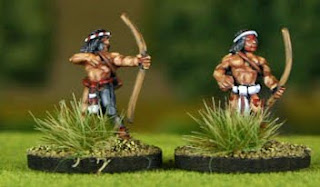
Next we come to their nobility who, very unusually for Mexico, used the bow, but this was supplemented with the macana, a wooden club/sword edged with obsidian. The macana had a loop for the warrior's wrist. The best interpretation of how they carried it whilst shooting is that they wore it dangling from their wrist as they shot, which to a non-archer like me seems precarious, but I've had archers assure me it would be no problem! You can only see it on one pose here because of the angle, but the nobles all have a macana dangling from their right wrist. They also wear thick fabric armour and helmets which sport fancy feather decorations.


Finally we have a leadership element, a warlord wearing a back standard, and a musician with a conch shell trumpet, common in this part of Mexico.

When the Chinantecs marched to the aid of Cortes, they arrived just too late to fight, and the captured rebels apparently considered this very a good thing! They are quoted as being very impressed with the martial bearing of the warriors. As can be seen from the images, the Chinantecs painted their faces and legs in black and/or red warpaint. They models are depicted in the long breechclout and sandals that were typical of the peoples of the area.

To read more about the Chinantecs, you may wish to consult Ian Heath's wonderful wargamer's guide, ARMIES OF THE AZTEC AND INCA EMPIRES, OTHER NATIVE PEOPLES OF THE AMERICAS, AND THE CONQUISTADORES (Armies of the Sixteenth Century).

This army is a new and fresh element to the DBMM game system, is also provided with a list in Field of Glory, and will also be included in the Field of Glory renaissance list, so it's one of those fortunate forces that sits astride time periods and allows you to use it for several different game systems. Should be released within the week, look for an announcement soon.

Saturday, February 5, 2011

The Control Battalions


After failures using various alien mercenaries to control the rebellious population of Sepulveda 7, and so that the incredibly valuable extraction of Angravium would continue unabated, the overlord of the Jo-eli Freehold, Jellina Jol-i I, decided to genetically craft her own soldiers. For this she used the vast resources of Sepulveda to oppress its own population -- the staggering wealth derived from the planet's huge stores of Angravium financed the scientific and medical research necessary to forge a race of supersoldiers from a witch's brew of human and alien DNA.

Naturally, this was a serious violation of Federal law, and accordingly the work was conducted in complete secrecy in the Black Tower, Jellina's fortress/palace built on an asteroid in the 368 Sumita system. In an effort to conceal the purpose of the research and experiments, each science team's work was very narrowly proscribed, fusing of the research being left to only the most devoted (and thus demented) of her scientists.


But no bottle remains corked forever. One young scientist initially excited about the research he was hired to conduct, David Rimmer, accidentally learned its ultimate goal, to his utter horror. With his own eyes he saw that Jellina was doing the unthinkable -- tapping the DNA of the ghastly creatures of another dimension, her transplanar expeditions finally having found, in the Imperial Maggots of the Maggoton Empire, suitable DNA for melding with that of humanity. What Rimmer spied one day in the top Secret TBA (Transhuman Breeding Area) was almost beyond comprehension -- part human, part maggot, these creatures were homicidal beyond description.

However, Jellina's scientists had found a method to keep them under control, using a chemical cocktail pumped into their lungs in a fine brown mist, constantly administered within the sealed domes of their permanently installed helmets. Sedated in this way, they made the perfect soldiers -- fearless, cunning and obedient.

Rimmer quickly decided on a course of action, sabotaging the TBA and fleeing the Black Tower, wearing as he went one of the special enviro-suits that scientists were provided to protect them from the intensely toxic Maggoton organic material. Rimmer vowed to stop Jellina's plan, and to aid the people of Sepulveda, whom he now realized were not traitorous rebels as Jol-i propaganda asserted, but rather freedom fighters attempting to throw off her oppressive yoke.

This was a setback, but Jellina soon had the TBA restored and thousands of Control troopers were being bred, domesticated, trained and sent off to Sepulveda where they were a rude shock indeed for the Resistance.

Operating in squads of nine, each used a pulse rifle, and the squad also included an SAP (Squad Assault Pulser) and a remote controlled drone which mounted both an HPW (heavy pulse weapon) and a grenade launcher. Operated by a remote pilot, the drone was often in the forefront of battle, its heavy chassis protecting it from small arms fire.

These troopers took the Resistance by storm, pushing them back on all fronts and asserting Jellina's control over the mining of Angravium, not to mention rounding up subjects who were suspected of Resistance ties -- to what fate, it is not known, for once rounded up, they never returned.

As they strode purposefully through the streets of Sepulvedan cities, villages and settlements, these strange masked troopers inspired fear but also intense speculation. Why had no one ever seen them remove their helmets, or eat or drink anything -- ever? Why when they spoke was it in a weird, digitally altered hiss? They became known, with fascination and dread, as the CoBas or, more often, simply the Helmets.

CoBa crews manned (if such a word can be used for transhumans) Jellina's motley collection of vehicles as well. A single company of CoBa infantry could have some of its squads carried in the MDMS Canetoad APC, others in the few remaining Atlas APMs acquired before the Federal trade sanctions, still others in the Hedgehog APC purchased from Nova Respublik, or even in the ramshackle Sod-Kafez 2.51 "Karkwagon" sold throughout the galaxy (usually for a song) by Karkarine military contractors. CoBa urban patrols were often conducted in the Locust Patrol Truck, these sinister black vehicles being widely used to "disappear" Resistance suspects in the middle of the night.

CoBa tankers similarly crewed Jellina's modest tank fleet, again a motley collection of vehicles including a handful of elderly Federal Silers, but mostly Nova Respublik and MDMS vehicles, including the redoubtable Taipan railgun-armed medium tank.

So successful were the oppressive activities of the Control Battalions that the Federation itself chose to intervene in the Sepulvedan Campaign, though at first covertly, sending Federal Marines in Resistance garb to aid the citizens of this war torn planet. For who knew what horror lurked within the bolted-on helmets of these strange troops, Jellina's obediant attack dogs?

We will soon be releasing two packs of Control Battalion infantry -- the rifleman set and the command and weapons set. Look for a release the week of February 7, 2011.

Tuesday, December 28, 2010

15mm Chaco War 1: Paraguayan Infantry


The Chaco War is one of those conflicts between the great wars which was fought in the "Back of Beyond" (to use the spirit, if not literally the meaning, of that expression) and has a small but obsessive following amongst wargamers. I like that! So I decided to make a set of models for the war, starting with the basic building blocks. Each army will have an infantry set and a support weapon set, the infantry set having an NCO, an LMG and six riflemen, the support set having a two MG teams and a mortar team.


The first set is done and ready for sale, I'm just waiting for the world to re-awaken from its holiday slumber before releasing them. They are the Paraguayan infantry. Four are barefoot, a condition so common in the ranks of this desperately poor army that the Bolivians called the infantry pilas. The officer has a Luger, the LMG is a Madsen, and the rifles are Mausers (the infantry weapon of this conflict). Three of the poses are wielding machetes, which was the dreaded and nearly ubiquitous close combat arm of the Paraguayan infantry, and also extremely useful in hacking through the tough, dry vegetation that was (and still is) nearly everywhere in the Gran Chaco.


It's not easy to get good information on Paraguayan uniform colours for the Chaco War, but the sources seem to agree that the Paraguayans went over to two green shades before the war began, an olive green and a darker colour. The olive colour had a slightly bluish tinge to it, or at least that's what surviving uniforms indicate.

The modern Paraguayan army units which dress up in Chaco-era uniforms for their annual victory celebrations wear hats and tunics of the dark colour and trousers in the olive colour, presumably as it looks more martial, but the images from the war suggest strongly that any of the items in the uniform -- hat, tunic, trousers -- could be either colour. That said, the one exception seems to be that the dark green would not have been worn without at least one olive item, so at least one element in every man's uniform was olive green. That is how we have had the models painted.

Next up will be the Bolivian infantry, called affectionately by myself and the sculptor the "milkmen" due to their uniforms. They are sculpted and I received them today in the post. I will be sending them off to the caster in a day or two and they should be available within the month.

The sculptor is making some other models now, including the Thanksgiving Contest models for Capt Jake, and command for the Arach spiderheaded infantry (for my upcoming sci fi black powder range, Rise of the Garn), but after those he will make the Bolivian and Paraguayan mortar and MMG/HMG teams. The Bolivians will be provided with Vickers MGs, the Paraguayans with one Vickers and one Colt -- they had very many captured Vickers in particular.

The mortar for both will be a Stokes-Brandt. The Bolivians actually began the war with almost none of these useful weapons as they scorned it as "poor man's artillery," but learned from bitter experience to acquire quite a few of them. The Paraguayans could not afford as many of the big fancy field pieces, so had a near monopoly of the "lowly" mortar in the first of their many victorious campaigns, when its mobility and high trajectory proved invaluable. When the Bolivians bought mortars the Paraguayans captured no small number of those, bolstering their arsenal still further.

If the line sells relatively well I will make SMG teams as well as artillery crew and perhaps even high command on horseback. If it amazes me and actually takes off, I may even have some of the aircraft of the war made, like the Curtis Hawk for the Bolivians and the Potez for the Paraguayans. (But don't hold your breath.)

Then again, who knows? It's one of those interesting interwar conflicts that are ripe for gaming using Flames of War, and can focus on the infantry combat as there were virtually no tanks or mechanized transports involved -- the tiny handful of tankettes used by the Bolivians being quickly dealt with by the Paraguayans.

The differences come largely from the style of infantry combat. The Paraguayans, whose officers admired the devestating German stormtrooper tactics they saw on the Western Front when observing (as guests of the French) during WWI, used those tactics very effectively. On the other hand, the tradition-bound Bolivians used denser and less fluid combat techniques, largely due to the leadership of a European high commander (ironically, a German). As a result, when they were on the attack they often launched frontal attacks and were mowed down in bloody heaps by the defending Paraguayans. Paraguayan attacks (and that was the more common occurrence) were usually handled better, with infiltration and envelopment being key to their many victories, along with the indomitable spirit of the Paraguayan infantryman himself. This fellow might not have been much to look at, but was arguably the most effective infantryman in South America.

Alternately these models, with their extremely obscure uniforms, would make ideal "generic" infantry for Red vs Blue wargaming, and would also make very colourful planetary defense forces for sci fi battles, something for your higher tech troops to chew up, or reinforce, as the case may be.

First release in a week or two ....

Tuesday, December 21, 2010

Los Viejos


The Molch Vornid War brought many mercenaries and guns for hire to the Molch sector to earn a living or get their kicks on the field of battle. Of all those, the most famous shots to participate were, of course, Los Viejos.

Hailing from Texmex 3, Los Viejos moved their herds of Landgrubs across the deserts, and while on the trail spent much of their free time target-shooting with their Foal Peacebreaker pistols, which fires a cartridged plasma round without any recoil. So accurate are they with these powerful longranged pistols, even when firing from the hip, it is said by some that they have never have missed anything they shot at. Whilst the accuracy of this statement has been questioned, the accuracy of Los Viejos has not, and all sentients live in fear of a duel with these small but formidable creatures.

At first it was the Vornids, merciless botanoid pirates, who called on Los Viejos. Showing up on Texmex, through a Kark interpreter they offered free passage and buckets of cash if only Los Viejos would sell their services to the Vornid cause. The hovering skimmer idled over the desert as nearby vaqueros gathered to hear what their chief, Armadil, was talking about with the sharkman and the silent, strangely undulating planet creatures.

As they gathered near they heard Armadil ask what the war was about.

The Kark hemmed and hawed a bit and then got down to business. The Vornids despised ugliness and there were no creatures in the galaxy uglier than the Molch. They all looked different, the Kark offered, but each Molch was exceptionally hideous in its own special way. The Kark went on to say that he himself had fought in two of the campaigns against the Molch because the pay was very good, and they were indeed quite difficult to even look at without vomiting up one's shrimpcakes in disgust.

"Si, that sounds awful indeed," responded Armadil very politely. "What have they done to harm your employers?" He removed his sombrero and fanned himself with it.

The Kark responded that the Molch had done nothing, as far as he knew. They seemed harmless creatures, but could unleash deadly psychic attacks when provoked, because they have very powerful intellects. They also had huge rock monsters that they animated straight out of the earth itself, again seemingly with their minds, and these creatures were maniacal in hunting down and hammering anyone who would harm the Molch. This part of the conversation seemed to make the Kark very uncomfortable, and it was apparent to Los Viejos that the Kark had had firsthand experience with these animated rock creatures.


"So what is the war about again, jefe?" persisted Armadil. "I still do not understand, for I am but a simple vaquero."

"Who cares," responded the Kark, a bit impatiently, "the pay is good. There is much excitement to be had." The Kark winked at them, but Los Viejos continued to stare at him blankly.

The Kark took a deep breath and went on.

"As I said, the Vornids hate ugliness and want to exterminate the Molch ... because they are ugly. They want to wipe out the ugliness as apparently it is too offensive for them to suffer to exist. I myself do not care, but it is warpay and it is good."

"But the Molch are famous for their philosophical thoughts," volunteered a vaquero who had been listening. He took a holo-tab out of an empty bullet loop from his belt and held it up. It was one of the journals that the Molch had sent into Federation space and which were best sellers all thoughout the galaxy. Other vaqueros muttered in agreement, the little sombreros nodding up and down in the audience. Each of them remembered, at one point or another in their lives, sitting around a camp fire at night while out on the trail and listening to the poignant thoughts of the Molch about life and existence in a way that moved the simple vaqueros deeply, making them look up and see the stars in an entirely different way.

"I am very sorry, my friend," Armadil said, "but we will have to decline your employers' generous offer. Please tell them for us. On second thought, we will let them know ourselves." With that, all of the assembled vaqueros pulled their pistols from their holsters and began shooting, rapidly blowing the skimmer and its contents to bits with small plasma rounds. They then dug a pit and buried the skimmer, its crew, and the money, which they refused to touch as precio de sangre, and began assembling to journey to the Molch sector. They would participate in the war, that much was certain.

Bob Olley has made us four poses of the dreaded Viejo gunmen in 15mm scale. They should be available to fight in the Molch/Vornid War, or any of your sci fi combat missions, in spring of 2011.

Monday, December 20, 2010

Garn Flesh Eaters


Largest, fiercest and strongest of all the Garn are the Flesh Eaters. Of course, all Garn are ravenous meat eaters, but this title is only used for these huge creatures. They bow to no one, other than the mighty Garn Hegemon warlords (who are often almost as large as Flesh Eaters anyway), and even then, the Hegemons are known to consult with the Flesh Eaters under their command as a human officer might respect the opinion of veteran sergeants in his command.

The Garn admire strength and power, and so they enjoy watching these huge champions slug it out in battle. Indeed some of the most exciting of the ad hoc gladatorial combats during the oppressive occupation of Sepulveda were the duels between a Garn Flesh Eater and a Sponk, the battles often going on for hours. Now and then the Flesh Eater would actually win (an amazing achievement indeed), and hoarse would be the throats of the Garn in attendance from bellowing their roars of approval.

Flesh Eaters wander Garn space looking for the most intense combat to be had, and are permitted to join any combat team they wish -- indeed this is seen as an honour by the unit they choose to join.


These 15mm scale models are big (even for Garn), and really imposing. Although the guns were designed as a superheavy flamethrower and a heavy fusion gun, naturally you can use them for whatever you want.

They are available now on our webstore.

Saturday, December 18, 2010

The AC-900 Sedan


The Augsburg-Corona 900 sedan is arguably the most popular sedan in Federation space, and is much sought after outside the Federation as well, being in particular popular with the Lhurggs, who enjoy pimping it up in various garish ways.


It features a large door which opens the windscreen to the right of the car, allowing everyone to pile in. The car can carry up to six people -- four in reasonable confort, or two who can virtually recline (and in the case of teenagers, often do).


Whilst designed for anti-grav transport, the bargain version of the auto is made with a conventional suspension, in triwheel mode, for those who experience grav sickness or live in areas where angravium fuel is at a premium.


Our model of the AC-900 was designed by John Bear Ross. It is in 15mm scale and is approximately 45mm long -- at 1/100th scale it's about the same length as a Toyota Camry. It's a simple two piece model with an upper car body and then a choice of inserts for either grav or tri-wheel suspension. The grav version has discreet little pegs on the bottom to suspend the auto a bit off the tabletop to create that floating feel.

It should be just the thing to stock your sci fi combat or RP games with cars that match your futuristic settings.


Coming in early 2011 -- stay tuned.

Saturday, December 4, 2010

HE WHO KILLS Part 2

(For part 1 of this TALE OF MYSTRI ISLAND, read the blog post below first.)

At this point there were no foes on the battlefield, there were only men (and one woman) filled with wonder, and at the same time a curious sense of impending dread.

As a girl, an orphan in Africa, I would play with the types of animals that other Europeans fled in terror, but when I heard that strange sound rushing through the jungle, even I felt the tingle of fear, running up my right leg and then my back. The sound, the sound – how can I describe it? Like a steel plate being dragged along a cobblestone road by a locomotive? Perhaps. To that was joined the violent report of heavy tree limbs bursting in the wake of this onrush -- a sound like nothing I had heard before.

Then I saw it.

At first it was a dark shape in the jungle, of great height although primarily horizontal, like a colossal battering ram rushing toward a gate. A battering ram with legs, for as it got closer two could be seen, thick as tree trunks, pumping back and forth as they surged the dark shape forward. Then it loomed closer still, into view, colossal, and the shape developed a head, which made it clear that Stalks-at-Dawn’s god was some sort of dragon, a huge squarish head with enormous jaws lined with teeth like railroad spikes. Thick horny crests ringed the top of the head and eye sockets. At first it seemed to have no arms at all, but as it drew nearer it fleetingly showed what appeared to be tiny wings, or at least small arms lined with feathers, for it could never had flown using them.


Such was our group astonishment that no one uttered a sound when this creature hove plainly into view. Stalks-at-Dawn fondled the amulet that hung from his neck, and held something odd in his other hand, which appeared to be a hunk of animal fur matted with drying blood. He watched He-Who-Kills quite closely as the huge beast peered around the jungle, its nostrils flaring. It had just swung that sledgehammer of a head in our direction when from the German lines came a single fearful utterance, “Gott in Himmel,” and the creature then snapped its head to the left and like a tidal wave surged down upon the German lines.

In amazement I turned for an instant to look at Stalks-at-Dawn, to gauge his reaction, but he was gone. Even before I could turn back I heard shouts and screams and gunfire from the German lines, the occasional shot thudding into the armour of this creature, perhaps stinging it no more than a hornet stings a man, as it thrust its great torso in and out of the trees. It would find a man, swing its great jaws open, and then -- and a ghastly recollection it still is -- clamp them shut around him, chopping him to pieces which tumbled every which way to the jungle floor. Again and again this happened, and I watched.

Try though I might to move them, my feet were frozen in place. I didn’t know what Richard or the Gurkhas were doing at this time because I couldn’t tear my eyes away from the scene of this carnage, this monster of myth who tore men asunder, this god so aptly named.

Now, with almost superhuman bravery, a mortar team manned their weapon, a clumsy squat German thing which appeared to be mounted on a wheel of some sort, and tried to depress it to bring fire of sufficient caliber on He-Who-Kills. They hastily discharged the gun and a portion of the canopy fell all around the great beast – too high! The monster seemed to interpret the blast from the mortar as a sort of challenge to its authority, and swept straight down on the hapless crew, who fled … but not fast enough. When it was finished with them, it turned and attacked the mortar itself, seizing the stubby cannon in its jaws and hurling it through the jungle like a toy. As it turned again, its great tail swept through the trees, and when one of these cracked a splinter must have been shot in my direction, for I was struck in the head and was out.

***


When I came to, there was silence, a buried feeling, and an earthy odor. My sight was blurry and I was disoriented. It was dark, then light, then dark again. Where was I? I was … in the arms of von Schrecklichdorf! Ensconced with him, it seemed, in a cave of some sort. Or was it a hollow tree? I felt clumsily for one of my pistols but he held me tighter and nodded with his blonde head to the left, to where the light was shining. My sight was coming back to me and in the sharpening of the world I could now see outside the tree, to the jungle foliage.

A shadow descended, then a huge leg came down with a thud, was rapidly lifted and gone, then a section of tail swept far overhead. Von Schrecklichdorf whispered to me, very quietly in his perfect English, “it is not satisfied yet. It is finishing the job. It smells our lives … and wants them for itself.” I ventured to lean my head ever so slightly out of the tree hollow, and there it was, almost in repose, craning its head out slightly, smelling the air. But it seemed confused now, almost distracted. Then, very suddenly, it swung its head straight toward me, locking eyes with mine. Fear seized me again and I began to tremble, but then it turned its head just as suddenly to the right, and pumped its legs, thrusting its vast muscled mass through the jungle, moving off.

We waited for a while in the tree, the Guards Jager officer and myself. When we had not heard He-Who-Kills for a while and the sounds of the jungle began to return, we slid ourselves out to the ground, still staying low, and put our backs to the great hollowed tree we had just been in.

After a while von Schrecklichdorf spoke. “Your friend, the Englishman, he kept his head. He took your soldiers down to the pier when the creature appeared. They dumped the cages with the Stossechse females into the cove. All twelve of them, and the two male studs too. The sailors shot at them from the U-boat but there was little they could do to stop it.”

I asked him for more details and he said, “I saw there was nothing I could do for the men, so my next concern was the mission. Yes,” he said with a grimace, “I can now admit what you already knew, there was a mission.” I smiled a little. “But I saw them drowning the Stossechse and I knew all was lost then -- my men and my mission. I did not see you with them, however, so I came back to look for you. It was prowling around, and you were unconscious on the ground, so I looked for a hiding place for you, and found this.” He slapped the tree. “I had to drag you fairly far, and it was touch and go for a while.” He paused. “But the creature seemed … distracted … first quite certain it knew where we were, but then confused and looking off in other directions. Almost as if someone or something was purposefully distracting it.”

I smiled again.

***


Many hours passed, and we sat and quietly recalled some of our adventures on the island, many of them so utterly without precedent that passersby overhearing us might have thought we were recounting mutual nightmares. When it was clear that He-Who-Kills was gone for good, and we heard quiet voices in the darkness, we got up and almost immediately saw Richard. He ran to us with a section of Gurhkas, his Webley not quite raised, and said, “Been looking for you my dear, were afraid we'd lost you." Turning to von Schrecklichdorf, he said, "You’re mission’s quite over I’m afraid, old man,” surprising me that his voice sounded almost regretful. Richard was always a gentleman, even to his enemies. “Yes, and I am glad of it,” von Schrecklichdorf replied. “I have fought in the trenches, I have seen men massacred before, but never by an animal, butchered so horribly, torn to pieces. It is no way to fight a war.” Richard was about to say something to von Schrecklichdorf but I interrupted him, which he hates, saying that it is very American. But I had to get it out right away. “I’m sorry I failed you Richard. I froze when it attacked. I should have gone with you and the Gurkhas to the cove. When push came to shove, I was of no use at all.” My eyes began to tear up and I was ashamed that I was behaving like a woman.

As had happened so often in the past, Stalks-at-Dawn materialized from the jungle, and came loping up to me, putting his hand on my arm. “Are you pierced? Is your health sound?”

Richard looked at our friend the lizardman and then at me, laughed and shook his head. “Failed? No, very much to the contrary, you were absolutely critical my dear girl.” He nodded his head to the creature he sometimes dismissively called Stalkers and said, “you befriended this chap, and he was man of the match on this day, there’s no doubt about that. I doubt he would have brought that terror down upon the Germans solely on my account.”

“No, I would not,” Stalks-at-Dawn replied, and we humans laughed a bit despite everything.

***


Although he was our de facto prisoner, in the end we let von Shrecklichdorf go, as frankly we were not sure what the legal niceties were when taking a prisoner on neutral ground. So he got back on his U Boat and sailed away to whatever fate awaits him. I had to cajole Richard into doing this, as he was most eager to make a prisoner of the troublesome, if gallant, German, and was sure he would pop up to vex the Allies again. As he was leaving I thanked him for saving my life once again, we agreed to look each other up after the peace, and he gave us that salute with the clicking boots.

Once he was gone, Stalks-at-Dawn explained to us that no creature fills He-Who-Kills with more fury than a male Giant Ape, and so the Reptilian Hunter had tracked and, with great difficulty, killed one, and had removed a hunk of flesh from its armpit, which he assured us has the most pungent aroma. With this grisly object he lured He-Who-Kills out of the deep jungle. “He is usually a quiet hunter,” Stalks-at-Dawn said, “but when an ape enters his home he is very loud and angry until the ape is dead, even if the ape flees.” For hours Stalks-at-Dawn had fled the rampaging beast, leading it all the while to the jungle above Madawan Cove, its jaws sometimes only meters from his back. He led it to the German lines where it destroyed them before my eyes, and then he had the equally difficult task of leading the creature back again to the deep jungle.

I asked him if this had ever been done by the Reptilian Hunters before. He told me gravely that it had not, and for this he was now an outcast in his tribe, despite the fact that he had brought He-Who-Kills back to his domain. And so it was that the Reptilian, once beloved of his tribe, was forced to leave his island, and it became my turn to teach him of the ways of the wide world beyond it.

--JP


We are very pleased to make available a model of the dreaded He-Who-Kills, based closely on the description of Janice Prishwalken, in 15mm scale. It is a towering beast indeed, and solid pewter! Some eyewitnesses dispute her observation that the creature had arm plumage, so this is an optional piece that may be left off if the gamer prefers. The model should be released during the week of December 6, 2010.

Tuesday, November 30, 2010

He Who Kills, part 1

Diary of Janice Prishwalken, March 1918:

When it all came to a head, the Reptilians were there for us in a way we could never have anticipated.

The Germans had backed us into a corner, trumping our platoon of Gurkhas with two good companies of German infantry, supported by light artillery. But despite all their cleverness and planning, their grim efficiency at exploiting the dark mysteries of this island, we had something they did not – we had Stalks-at-Dawn, first a curious onlooker, then a guide and yes, a friend.

And finally, our savior.

We’d heard about it for months, this god of theirs, ominously named “He-Who-Kills,” who lived in the deepest jungle and held sway over that mysterious place. It is said that no human who set foot there had ever come out alive, and I’d not met anyone who tried. Even the Savannah Lords and the armies of the local powers on the island avoided venturing into this deepest and darkest of all the island’s jungles, even if in force. The sheer thought of it was madness to them. The feathered reptiles themselves built their nests a respectful distance from the domain of He-Who-Kills.

Precisely what He-Who-Kills was, Richard and I had pondered many times, occasionally even imagining, upon encountering some new monstrosity, that we had perhaps this time run into He-Who-Kills himself, only to draw looks of bald amazement from those who knew better. On several occasions Richard asserted to me that it was but a myth held in reverence by savages, but he listened attentively all the same when the Reptilians referred to their spirit master in that oblique way they reserved for him alone.

Whenever humans from the island were asked about He-Who-Kills, they invariably said that they did not know and did not want to, for anything that put fear into the Reptilian Hunters was something they wanted to avoid at all costs.

Only the Reptilians would slip into that deepest recess of the island and return to tell the tale. Or at least, sometimes return. Young braves, now old enough to join their tribe’s hunters on foraging expeditions, had first to pass a test. To prove their bravery and skill, they had to bring a small wooden ring into the domain of He-Who-Kills and leave it on a certain branch of a certain tree, then take the ring that the previous young Reptilian had left on that same branch, perhaps years previously, back to the tribal elders. Some of the young Reptilians never came back from that fateful journey, and in this way the tribe assured that only the surest and quietest of their number would sweep forward on the daily hunts.

Our efforts to coax a description of He-Who-Kills from the Reptilians were always frustrated, and we eventually resigned ourselves to the thought of leaving the island with this particular mystery remaining unsolved. But it was not to be, and in the end we had all our questions answered.

* * *


We had learned much of Captain von Schrecklichdorf’s master plan -- to gather a dozen egg-laying females of the dreaded “bayawak balahibo” (feathered reptiles) and bring them back to Germany by means of the huge transport U-boats that crept into Madawan Cove. In the platoon of Gurkhas that had joined us just in the nick of time, we thought we had the means to stop him. But von S. was not a man to be taken for granted, and to our astonishment we discovered that he had brought superior force to bear, no doubt carried on the U-boats that came to retrieve the feathered reptiles in their wood crates. Von Schrecklichdorf wasted no time in sending his little army after us, and our brave Gurkhas, vastly outnumbered and outgunned, could only fall back as the German forces pressed us.

It got worse, for we soon found ourselves surrounded, two squads of the fearsome stormtroopers having crept into the jungle behind us as we fell back. This was just as Stalks-at-Dawn had predicted when he had mysteriously left our party in great haste. The Reptilian Hunters had rapidly familiarized themselves with the “bang-men” (their term for stormtroopers because they use grenades so frequently) and knew they’d have something up their sleeve. He had tried to warn me about this two days before, as the Gurkhas were joining us, but he could not quite find the right words, and I could not let his vague cautions interfere with doing our duty, which was more urgent now than ever. Eventually he stopped pressing me and gesturing, looked at me for what seemed a long time, told me he would try to do what he could to help, and disappeared into the jungle.

He was right, as he always had been, and our moment of triumph had turned into our moment of doom, for neither Richard nor I had any intention of leaving the Gurkhas and planned to share their fate whatever that might be, Richard firing his Webley with his normal deadly accuracy, his pith helmet off but his tie perfectly straight as always. I looked at him there, crouching behind a tree, splinters flying everywhere, and as I stuck another clip into my .45, my own adventures on his astonishing island flashed before my mind’s eye ….

…dinner at the table of the Brothers Hamyldon, the vampires Georg and Vlad, Georg insisting that I wear an evening gown that appeared exceedingly antique …

… negotiations with newly-sentient penguins to join our cause …

… a midnight game of hide and seek in the jungle with those crazed, gibbering cannibals, the Getinmahbeli …

… pursued across the grassy interior of the island by the colossal Savannah Lords …

… more than one face-to-face encounter with that dashing gentleman, von Schrecklichdorf himself, who always asserted with a smile and a shrug, his uniformed stosstruppen around him, that he was simply a German gentleman on vacation, and here only for the hunting …

… and all the while, through the highs and the lows, Richard and I never gave up hope that right would prevail in the end. But now here we were, trapped and outnumbered, mortar shells exploding around us as the Gurkhas fought and died tenaciously for every inch of jungle, fire coming at us now from behind as well as front, ever closer.

But what was that sound, a sound like living thunder? All fire ceased as that roar drowned out even the mortars, rattling the bones of every man, Gurkha, German and Briton -- and my American bones too, the only woman present. Squinting toward the enemy line, in the distance I made out Captain von Schrecklichdorf as he rose up slowly amongst the grey helmets bobbing in the bush, his handsome Broomhandle Mauser in hand, peering in the direction of those thunderous bellows, which were now mixed with the sound of cracking tree limbs as something surged through the jungle.

I felt a familiar presence and Stalks-at-Dawn materialized from the bush, panting. He crouched, pointed in the direction of the sound, and said, “He is here. He-Who-Kills is here.”


To be continued ....

Monday, November 8, 2010

Garn Merchant-Warship


The Garn, hulking alien reptilians, do not understand what a cruiser is because the Garn do not "cruise." Instead, like a monitor lizard seeking prey, they relentlessly pursue opportunities for conquest or trade advantage. Showing the flag on a cruise is meaningless when there are worlds to be dominated or trade gains to be realized. However, as the ship they use for this purpose, the Merchant-Warship, is roughly the size and strength of a Federal Cruiser, it is designated a heavy cruiser by the Federal Navy.

Federal Naval jargon has dubbed the ship the "MerWa."

The Merchant-Warship can carry two to four turrets each mounting two of the mighty Vulcan Naval Rifles, and batteries of ship-killing heavy missiles (which can be retasked for heavy surface bombardment in support of the ship's troop complement). Alternately two of the Vulcan-mount turrets can be replaced with cargo or launch pods if the ship is seeking a trade advantage rather than straight conquest.

Merchant-Warships do not carry fighters, but are well defended against them, bristling with close defense laser systems. The ships have both heavy armour and forcefield defenses.


As these vessels sail on missions likely to include interaction with aliens on the surface of distant worlds, they always carry a strong complement of warriors and tanks, the huge Crocodile and Alligator class anti-grav vehicles. Indeed this is an intrinsic part of their purpose. In combat with another spacecraft, the powerfully armed and protected, but generally less maneuverable, Merchant-Warship will attempt if possible to send landing parties to the enemy vessel in order to capitalize on the Garn advantage in close quarter combat, and potentially sieze the enemy craft as a prize, garnering honour and cash for the task force's Hegemon.

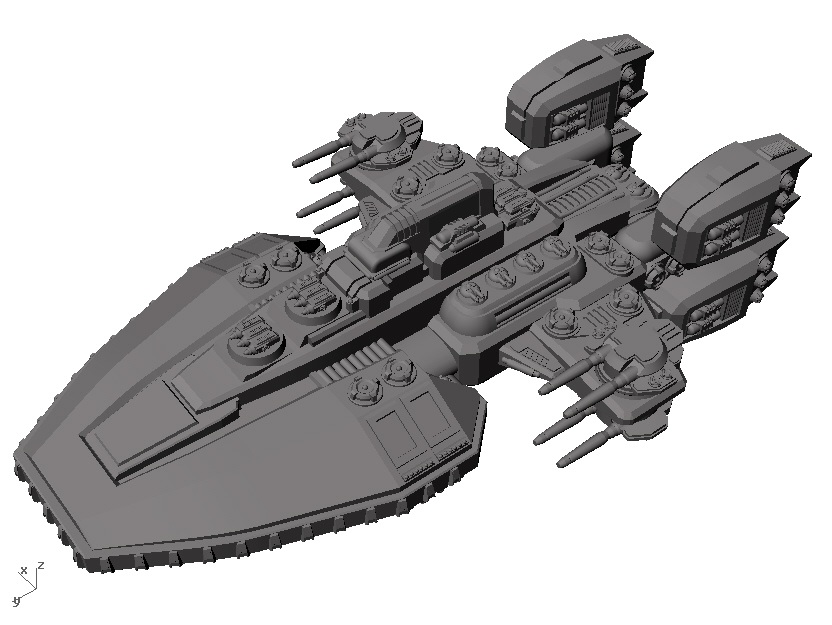
Our model of this lumbering alien cruiser cum troop transport cum merchant ship was designed by John Bear Ross and will be released as an adversary for our upcoming Federal Battle Class Heavy Cruiser. And coming soon into scanning distance, its weapons hot and armed, is the Pelagic Dominate's sleek Benthic Class Battlecruiser ....

Tuesday, September 14, 2010

Atlas Class APM

Here's the first look at the Atlas Class APM (armoured prime mover).


This heavily armoured tractor is armed with a rotary cannon mounted in a turret, but its primary use is to carry a variety of payloads into action, including the APT (armoured personnel trailer), as well as the JUGC (joint use gun carriage), which will have a mount for an AAA suite, a heavy artillery piece, and an MLRS.

Also planned is a dropfit guntruck rear that will carry several men and lots of guns for patrol purposes. This won't be a trailer, it will be a direct attachment to the back of the APM.

The design of the Altas is inspired by current combat conditions, such as the use of MRAPs and the Stryker in ongoing wars. Wheels seem to be the way to go, or at least one viable way. Also, from a marketing perspective, there are so many one-bodied APCs out there, and so many tracked or grav carriers, that we thought it would be fun and different to introduce a wheeled and articulated APC/Gun Carriage into the market.

The Atlas will be joined soon by the gigantic Siler Superheavy Tank, and its passengers, the Federal Army infantry, will also be released imminently, with more planned.

In a day or two we will preview the APT (armoured personnel trailer) that hooks onto the Atlas. The APT mounts a heavy grenade launcher to get those pesky skulking aliens that can't be blasted into pieces by the direct fire of the APM's rotary cannon! The trailers will all be sold separately of the tractor so that you can multitask your vehicles. Stay tuned!

Thursday, August 26, 2010

664th Anniversary of Crecy


On the 664th anniversary of the Battle of Crecy, arguably the battle that made England a great nation (at least, in the eyes of the rest of Europe), we are previewing two codes from our upcoming 15mm Crecy line. These will compliment our existing mid-14th century line, the Early Swiss, and we hope to eventually make many other nations from that period as well. (I was going to call it "Circa 1350" but it occurs that it could just as easily be called the "Black Death" line!)

Above are the English archers, three armoured and three unarmoured. Every effort has been made to fix their armour and dress so that they are accurate for that fateful battle in the twilight.


Also being previewed are the Welsh knifemen, who had a spear and a long knife with which they ruthlessly finished off wounded French men-at-arms.

The foot knights and command will be previewed when the painter is back from holiday! All models are cast and ready to be sold as soon as all are ready to be displayed for sale, perhaps within a month.

Wednesday, July 14, 2010

All Meat for the Sponk


The Control Battalion sergeant peered through the goggles on its factory-sealed helmet and considered what it would say next to the obstreperous Lhurgg chieftain standing before it. They had met in the middle of the street, leaving their respective troops hanging back in the rubble on either side of the street; best to keep them apart to avoid any trouble, and have their leaders meet in neutral ground.

The sergeant was part human, but it rarely felt any emotion, as the DNA that had been mixed with that of Humanity in the process of creating the Control Battalions was dominant, to put it mildly, and the creatures that had provided those genes were coldly calculating in their every action, knowing without feeling.

And so the sergeant had the presence of mind not to immediately kill the Lhurgg standing before it, an action a more emotional being, such as a full human, might have been sorely tempted to take against this mercurial, shiftless and selfish creature.

Killing him would not do at all, as the Commander had given instructions to her Control Battalions concerning the Lhurggs: they were only to be eliminated if they were directly impeding Control Battalion activities in the sector. Otherwise, the Commander said, their disruptive presence was now actually rather useful on Sepulveda, and so even if they would not follow orders, they must be left alone. She had reasoned that if the Lhurggs were allowed to remain, some colonists might see the Control Battalions as an acceptable alternative to them. The sergeant had just enough human DNA in its makeup to see the sense of it.

Of the history of this conflict, the sergeant knew as much as it needed to – that the Commander had hired ten thousand Lhurggs to enforce her will on Sepulveda against the Sepulvedan Resistance, and they had failed to do that, occupying themselves instead with what they did best, looting and piracy, and then arguing and fighting amongst themselves over their ill-gotten gains. She had anticipated this, and indeed who wouldn’t, but what had caught her unawares was the utter imperviousness of the Lhurggs to repeated demonstrations of her displeasure, usually administered by a platoon of her Garn bodyguard dropping down from orbit to, say, snuff out a Lhurgg encampment. So shortsighted were these creatures that such ghastly lessons did nothing to affect their behavior. Far from getting the extraction of the precious Angravium mineral back on track, the invasive presence of the Lhurggs had brought it to a standstill as every colonist who could bear arms did so to make war on the Lhurggs as if they were so many locusts -- which is essentially how they behaved, swarming here, denuding an area, and then swarming to the next place, leaving many of their dead on the ground as they ebbed.

The Commander had next hired fully seven arks of Karkarines, Pelagic mercenaries who were good soldiers and much better organized than the Lhurggs but, it turned out, not much better behaved in mercenary service. They were instructed to rein in the Lhurggs and to force the miners back to work. They did not obey those orders, those seven thousand Karks, but acted instead as a force unto themselves. They mostly stayed in their encampments, watching pornographic and action hols as they wallowed in salt-water tanks and ate freeze-dried shrimp-cakes, suiting up now and then to make the occasional token foray to obliterate some Lhurggs or, more often, to cut deals with the organized crime heads of the Sepulvedan Underworld. (Karks did not have nostrils but could still smell money five clicks away.) They also extensively mapped the planet, the Karks did, although for what reason it was not immediately clear.

The Karkarine Mercenaries were of little help against the Lhurggs and of no help whatsoever against the Resistance, but at least they were easy to get rid of – the Commander just told them she would no longer pay them and they got back in their arks and departed the planet without a word, leaving nothing but pools of brine where they had once encamped to show that they’d ever been there at all. It was officially said they had all gone off to the next sector, offering their services to both sides in the ongoing Molch-Vornid War, but the sergeant knew well enough that a few Karks remained as middlemen for some bad apples in the Commander’s Garn bodyguard battalion, who were getting rich in their sales of looted Resistance weapons to the Sepulvedan Underworld. Those weapons, the Platoon Leader knew, went right back into the hands of the Resistance. It felt a rare, momentary rise of anger, but that quickly dissipated. Anger at the Garn was pointless, for against them a transhuman such as itself could do nothing.

The sergeant’s mind had wandered on these matters for a few moments, and so it had not been listening to the Lhurgg, but then again, there was little need to. The Lhurgg interjected only a few words of FedCom as he coughed and brayed in his own language to the sergeant, shoving, gesticulating, pleading and demanding. The sergeant gathered that the answer was no, the Lhurggs would not support the Control platoon’s left flank as they tried again to push their way down Alliance Street. The platoon had left eight dead on the street with the last push, not that the Control Battalions cared about their casualties, but losses made the platoon less effective. The sergeant knew of course that these same Lhurggs who refused to assist would follow right behind its platoon all the same, looting any dead (Control Battalion, Resistance or bystander) that resulted from the action. That’s why they had gathered here now -- they’d been attracted to the fight.

The Lhurgg then asked, again, for elec-chem cells to power his herd’s swords, holding his palms to the sky.

Peering through the brown mist that coursed inside its helmet, the sergeant replied -- lying, of course -- that it would consider the request, and then asked its own question, slowly and deliberately so that the Lhurgg would understand. “Has your herd seen any more Resistance fighters with rocket launchers arriving in this area?” Its question came out of a speaker on the side of its helmet in a sinister, hissing monotone.

Edrardu gilla helma lets me think, no? I finds out, gorshu,” said Honq, the Lhurgg chieftain, in reply, and leered at the sergeant standing before him. Honq momentarily pretended to ponder the rocket launcher question, squatted slightly, grunted and shot a bolus of warm, wet feces onto the ground, splattering the boot of the sergeant, causing some of the Lhurggs reclining on the rubble to bray and hoot.

“Helma” -- the Control sergeant rolled the word around in its brain. This meant “helmet,” which is what everyone called the Control Battalions on Sepulveda, “the helmets,” because they never removed them.

Ever.

Honq turned to his cackling herd and said, in their own language, “these helmet creatures have elec-chem cells, for I asked for some and they did not say no, so they must have some! What do you say to this, my kin?” The herd looked up, and each of them pulled his Huk-Huk sword a little from its scabbard, then let it slide back down, click. Having run out of battery power, their Huk-Huks had been quiet for some time, although they still had considerable bite, even if their two adjacent blades were not reciprocating back and forth under electrical power. The herd had some disposable blasters, it was true, but as everyone knew, they couldn’t hit anything with them – the Lhurgg was defined by his Huk-Huk, and the Huk-Huk existed to make its grinding sound as it bit into the flesh of the foe.

The herd wanted those elec-chem cells.


“Here, come my child,” shouted Honq, and the Lhurgg giant rose, lifting himself heavily from the street using his mallet as a prop. Fully nine feet tall, the giant had three heads, which had been quietly arguing about something but they were now quiet and attentive as they frowned at the Control platoon. This was met by clicking and whirring sounds as the goggles mounted on Control helmets zoomed and focused on the giant, and on other Lhurggs who were now materializing from the rubble and gathering around. In the giant’s right hand they saw the assault cannon, three barrels now yawning at them.

The sergeant had counted the Lhurggs before, but now that they were gathering it saw that it had underestimated their numbers, and there were sixty or more of them, more than the remnants of its platoon, most with disposable blasters and all with the crude power swords they preferred in close combat. The swords were drawn and their chieftain barked and spat at them, pointing to the Control troops. They began advancing.

They were, in the sergeant’s judgment, now directly impeding Control Battalion operations in this sector. It hissed and went down on its knee.

* * *


On the roof of the old ministry building, Resistance Corporal Hallan, looking out for the Control troops with his binocs, witnessed it all.

He knew they wouldn’t come strolling down this street, of course, but he might see something anyway if he kept watch. And sure enough, out comes a Control leader walking cautiously into the middle of the street, far out of range, and then coming to join him from the other side of the street, a feathered Lhurgg chieftain. They talked, uneasily, or rather the Lhurgg did most of the talking. He could hear nothing of the meeting, for these old Resistance binocs didn’t have aurals. He had feared that the savages would join up with the Control platoon as they again tried to push down this thoroughfare, and considered asking Lili if they could drop a few rockets in amongst them at this extreme range, but before he could do so, and much to his amazement, a battle had begun …

… flashes of white light, obviously from Control pulse rifles, their normal disciplined fire etching streams of light across the street …

… the heavy thunder of a Lhurgg giant’s assault cannon …

… Lhurggs bounding into view, attempting to cross the curtain of fire, their crude swords held high overhead, some making it …

… the unmistakable whir as a Control drone’s propeller kicked to life as it took to the air, firing grenades across the street …

… the Control unit leader kneeling, still in the middle of the street in advance of all its troopers, laying down a steady fire, killing one charging Lhurgg that was virtually on top of it ….

… and finally, gradual quiet, except for the occasional hiss from a pulse rifle and the whirring of the Control drone’s propeller as it now floated into view, hovering cautiously across the street, evidently checking out the position the fleeing Lhurggs had held, the Control leader following slowly behind it, finally the rest of the platoon advancing into view.

His enemies had just made war on each other, and Hallan was relieved. But felt no great pleasure. There was nothing new in this. Everyone fought everyone on Sepulveda, or so it sometimes seemed. As the saying went, it’s all meat for the Sponk -- a saying that could be taken quite literally out past the city limits, where Lhurgg and human skulls mingled with emptied Control helmets at the bottom of the predators' burrows.

Hallan let his binocs swing around his neck, and called Lili’s adjutant to report what he’d just seen.

* * *


Models of the Lhurggs have just been added to our 15mm line and are available now. They were sculpted by Whiff Waff and these samples were painted by Artmaster Studio. Lhurggs are tall, slender creatures that go about naked and are usually armed with a cheap disposable blaster and with the Huk Huk electrical sword.

Thursday, July 1, 2010

Enemy artifact


Highest security level applies to transmission ++


Hostile civilization artifact discovered on outpost Planet R ++


Outpost destroyed ++


Colonists missing ++


Artifact appears to be antigrav skimmer ++


Lifeform appears to hang upside down from "seat" on top of vehicle ++


No known organism capable of piloting such craft ++


Initial weapons assessment team poisoned by physical contact with craft ++


Fatality rate 100% ++


Xenobio team to further investigate once satisfactory safety protocols established ++


Transmission end ++

Wednesday, June 23, 2010

Tales of Mystri Island: The Stossechse

The details were kept a closely guarded secret, but part of the Italian trench line taken by the Germans at Caporetto in November of 1917 was not seized by their vaunted Stosstruppen. In one or two selected points on the battlefield, something worse even than the stormtroopers was at play. In those sectors the Italian defenders were utterly wiped out before they were able to withdraw -- worse even than wiped out, torn to pieces, their bodies mangled, sometimes beyond recognition. Only one man survived, a reliable veteran Sergente, but he had been driven insane, and to this day shields his face and screams for no apparent reason. The Germans had here unleashed a weapon that, in its war-winning capabilities, might eclipse the flamethrower and even poison gas itself.

With great effort, Allied intelligence eventually determined from scat left in the assaulted trench sectors that this weapon was biological, apparently some sort of … animal. The Bosche seemed to hold it only in limited quantities at present, or they would have scythed down the entire front, a ghastly slaughter. Thank God for little miracles, though this was literally cold comfort to those torn limb from limb in their trenches.

It was a Belgian spy who first caught wind of the likely origin of the new Hun menace, in the summer of 1917, in fact a few months before Caporetto. She heard two German officers speak obliquely about the “dividends being yielded by a Guards captain on an island in the Pacific,” and how those may “some day yield triumph for the Fatherland.” She passed this information on to the British Secret Service, and it floated around Whitehall Court for a few months, usually described with evident amusement as “Jerry’s Witch Doctor Battalion.” But after Caporetto an enterprising intelligence officer put two and two together, and a team was established specifically to investigate what the Germans were doing in the Pacific. As the Secret Service learned more, two agents, an Englishman and an American, were sent to Mystri Island to see what they could find out. But doubts persisted -- could the obliteration of two full platoons of good Italian infantry be caused by something biological, found on a remote island?


* * *


Von Schrecklichdorf beckoned the party on, his Broomhandle Mauser now heavy in his hand and still hot from use. The native porters remained jumpy from the previous attacks, and clearly expected to see more of the vicious feathered reptiles bolting from the jungle at any moment, but the cadre of German explorers had moved these eggs around on Mystri Inland before and knew that the coast was now clear. The creatures, which Gotz had christened “Stossechse,” would not attempt to retrieve their eggs this far beyond the river.


Good thing too, v. Schrecklichdorf thought as he spat in his monacle and rubbed it on his bluse to remove a blood splatter. Nine more porters killed, over fifty rounds of invaluable K98 ammunition and six grenades expended ... defending six animal eggs. Not that the local tinpot dictator cared a whit about the losses to his own people, but it was getting harder to obtain carriers, conscripted or not, who would not flee as soon as the opportunity presented itself. These simple people, he thought ruefully, nursing a surface gash on his left forearm, had the good common sense not to transport demon eggs out from the deep part of the jungle.

Von Schrecklichdorf allowed himself to relax a little. “Stossechse.” Something right about that name -- “assault lizards” -- yet something so very wrong all the same. Scaly skin and a face like a lizard, but feathers like a bird, and a taut, wiry body like nothing he’d ever experienced before. What were they, besides damnably dangerous?

Well, that was a question for men in white lab coats back in Germany to answer. But what he did know was that these were the first animals he had sent back to Germany that led to clamours for more. Though in their wild state they were incredibly dangerous, in fact nearly suicidal to approach, the creatures were, he was told, domesticable when raised from the egg, and made awesome weapons. (Von Schrecklichdorf tried to image that for a moment.) This was good. He had not come here to fail the German people in their hour of trial. He would collect more of these eggs, and no one would stop him, he thought, looking around the jungle, the hairs now standing up on his neck. He had that old feeling again, like he was once again being watched, but not by Stossechse.

Janice sensed her German subject was aware of her, as she slipped through the jungle, Richard right behind her ….


* * *

Comparison to a 15mm sci fi model

We will soon release a pack of von Schrecklichdorf’s Stossechse (pronounced sh-tows-egg-zuh), dinosaurs now known to science as Deinonychus, often called "raptors" in popular parlance. There are six different poses and the animals are represented in line with the most up-to-date dinosaur science, so they are covered in feathers for heat regulation as well as display. They represent medium to large “raptors” in 15mm scale, but are perfect for 28mm scale smaller “raptors” such as Velociraptor (not the movie monster, the actual animal, which was about the size of a German Shepard).

Sunday, June 13, 2010

Mike Broadbent paints the L-HAC!


Most of you will know Mike Broadbent as one of the world's top rank sculptors of wargaming miniatures, but Mike is also a painter and a gamer, and I was very pleased indeed when he ordered several of my L-HAC models! This was designed by Mark Mondragon and, at about 100mm tall, is huge and imposing even to 28mm models.


That's how Mike says he uses his, as death droids in his 28mm gaming. Here are some pics he was kind enough to share with me.


Thanks Mike. The L-HAC is available in the Terran Federal Marine Corp. area of our 15mm Sci Fi webstore: http://khurasanminiatures.tripod.com/15mmscifi.html