Thursday, March 31, 2011

The Molch Vornid War


One of the many body forms that Molch "extensions" take


The Molch Vornid War is an ongoing, localized conflict outside the boundaries of any of the great spacefaring races, in the FUZ (Fifth Unincorporated Zone). The Molch, a peaceful and intellectual, but physically hideous race, have long provided the sentients of the galaxy with thought provoking philosophical tracts. Be this as it may, they have nonetheless attracted the unkind attention of the sentient Vornids, botanoids (plant creatures) who, apparently on religious grounds, are incapable of tolerating the extreme ugliness of the Molch and are conducting a holy war to “cleanse” planet Molch of its occupants.

A Vornid commander


Invading Molch in force, despite its considerable distance from Vornus, and setting up fortified bases on the planet, the Vornids initially conducted ghastly sweeps in which they annihiliated the peaceful Molch who naively came to greet them as friends.


But soon it became apparent that the Vornids had started a fight rather than a massacre, for the Molch, when given no choice but to defend themselves, are capable of just that, conducting tenekinetic and psychic attacks of startling destructive power.


The Molch also proved more difficult to eradicate than anyone had anticipated – while the details are still unknown even to the friends of the Molch, each individual creature seems to be a physical “extension” of one or more vast beings which reside at the core of the planet itself (or, at least, somewhere under its surface). When a Molch extension becomes elderly, it disappears into certain designated caves called life-portals and soon thereafter another Molch extension emerges, unlike the first and fully mature (there are no Molch children, nor do they appear to be separated by gender). Thus, as long as a Molch extension, living or “dead,” is capable of being transported into one of these caves, it will soon emerge as a new extension. In this way many sectors which seemed “cleansed” by Vornid attacks were in short order heavily populated by Molch again, aimlessly wandering about and chatting amongst themselves, as they are wont to do.


And so at first the Molch seemed quite capable of defending themselves against the Vornids, who had opened this campaign with very aggressive tactics, sweeping straight down on Molch population centers in their slaver galleys and engaging the Molch at point blank range -- the very range at which Molch psychic blasts were at their most devastating, ripping Vornid troopers to pieces or turning them inside out, their slaver galleys brought down in flames. And at their command, certain types of Molch were able to animate stone into vaguely human form (the form they had long ago noted to be most effective for close combat). These towering stone constructs, the Molch Defenders, had only one purpose -- hammering the foes of the Molch – and they never slowed or tired in its pursuit. Although they could be destroyed with enough firepower, the Defender-construct battalions were phenomenally resistant, and utterly terrifying foes in close combat.


But the Vornids rapidly adapted their tactics around the strengths of their hated race-enemy, as was their way. Now they take to opening battle by bombarding Molch population aggregations from space, then move the slaver galleys in to conduct long-range direct fire from nape of earth, often many kilometers away, bringing the devastating power of the mighty ventral rifles to bear, and closing in only when many Molch have been “killed” and Defender-constructs smashed into pieces. This has proved to be a very effective tactic and evens the score in the resulting close quarters battle.


Not achieving the instant victory they had anticipated, the Vornids supplemented their own expeditionary crusading army by hiring large numbers of mercenaries from far and wide, a rogues’ gallery of pugnacious alien regiments exploited as cannon fodder but also at times hired for their specialist combat skills. Kark and Stick regiments served the Vornids in large numbers, using their native vehicle technology to carry the fight to the Vornids. Felids also joined the fight, sub-contracted by the Garn reptilians who are the overlords of the Felids and who have close economic relations with the Vornids. Indeed the Molch-Vornid War is just one of the many campaigns the Felids have had to endure when they have no enthusiasm for the fight and no love for their employers. As one Felid wrote back to his cub, “there is no honour in making war in this way, my imravi … using long range firepower to blast peaceloving creatures … making war upon animated stone machines … serving detestable, emotionless creatures which sway like the weeds in the breeze, stink like a bog, and have no faces. This war wears us down, imravi, but heed my words -- disloyalty to our masters, those who rose us up, would be more dishonourable still.”


The Vornids quickly came to the conclusion that the key to victory was destroying or at least neutralizing the Molch life-portals, striking at the mysterious underground “essence” that generated the individual Molch. And with each battle they are gradually achieving his goal, establishing bases closer and closer to the life-portals, although at bitter cost. Detest it though they may, soon the embattled Molch had to consider adopting some of the methods of their Vornid enemies – by spreading it out to other races, reaching out, somehow, to someone who might help them to preserve the Molch essence that continuously dwelt below the surface for millions of years.


But how? Contact with the humans, their faraway spiritual allies, was impossible due to the extreme human reaction to the Molch physical appearance, which invariably brings insanity with long enough exposure. And only through the humans, with their vast net of contacts and communications, could they hope to approach other races to seek out help.


The Essence pondered this question, and then came to a conclusion – it would create a new kind of extensions, these to be shaped like the humans, which would hopefully be at least tolerable so that humans and Molch could communicate in close proximity. And it set about attempting to generate such extensions, at first bringing to being many that were wholly unsatisfactory, and had to be folded back into the Essence. It was a grave expenditure of energy and thought at a time that this could be ill-afforded, but finally, with the crucial help of one selfless human philosopher who traveled to Molch and gave her sanity so that the Essence might better understand human physicality, extensions began to emerge which vaguely resembled human life forms. They had no tenekinetic powers, and were thus unable to defend themselves. As a wholly new variety of extension, they did not have much of the wisdom of the Essence, and were often naïve and fearful, and the Essence fretted over them. These new extensions were indeed still hideous to human eyes but at least were not madness-inducing to gaze upon and communicate with, and they conquered their fear and feelings of vulnerability, traveling out alone, spreading far and wide, seeking human help wherever they could find it. They called themselves the Molch Emissaries.


And these kindly, hideous creatures achieved their goals, and human help came.


Billions had read, heard or digi-grated the philosophy of the Molch and taken it into their hearts, and were willing to tolerate the nausea-inducing appearance of the Molch Emissaries in order to save the wise and kind spirit that had generated them. Forbidden by federal law to serve as mercenaries, the humans either arranged for the Molch to hire alien mercs, or served themselves, outside the law. Entire battalions were formed, some idealistic volunteers, others mercenaries hired by human donation, purchasing their arms from Mercanto-Dett Military Solutions, the great multiplanetary corporation based on New Australia, or from the black market, these being mostly Nova Respublik weapons and vehicles. In coordinating the actions of these human battalions with the overall Molch defense, the Emissaries proved their worth again, acting as communications links between the humans and the Molch, who the volunteers could not set eyes upon without going mad.


Human financial contributions also hired Kark regiments to assist the Molch, and these fought well, sometimes against their own kind, bringing their native-designed vehicles with them.


Combattants of the Molch Vornid War, seen to scale -- a Felid, an Ursid and a Molch Defender-construct

Further allies and mercenaries came to the Molch almost by accident. Perhaps the best example of this was those famed Armadilloid gunfighters, “los Viejos,” who were at first approached by the Vornids to serve as mercenaries but upon hearing the grisly details promptly killed the Vornids and traveled to join the Molch side. While they were not pleased by the appearance of the Molch, they served right amongst them, often acting as an elite close-range fireteam, for it is said that los Viejos never miss a target they fire at with their dreaded plasma sixguns.


Another example of such a fortuitous alliance involved the Ursids, massive, phlegmatic creatures who have been exiled from their Federal homeworld and now travel the galaxy selling their services to the highest bidder. The Ursids love a good brawl and bring daunting firepower to bear – their standard armament is a BPFG (bear-portable fusion gun) which can crack open a heavy tank at long range. First sub-subcontracted by the Felids, the Ursids immediately took a disliking to the conflict and particularly to the Vornids, and at the first opportunity changed sides, working for less than their normal wage, which was to be paid by human donations. The Ursids have become accustomed to the appearance of the Molch, although like virtually all sentients they find them to be disturbing to be around for too long a time.


Regarding the war itself, the Molch are, as always, philosophical. They seem to take it almost in stride that the Vornids are fanatically seeking their destruction, and have even published poignant tracts in which they plead with other sentients not to judge the Vornids too harshly for their actions. This does not mean, however, that they permit the Vornids to destroy them or penetrate the secrets of their subterranean essence, and the fight goes on, with no quarter on either side.


One thing the Molch truly do fear, however, is that this war will eventually draw the attention of the Cult of Andromeda, as local wars often do, as flies are drawn to a corpse. About this the Molch are very clear – the Cult presents an existential threat and is never, under any circumstances, to be suffered to survive. Few creatures have pondered the universe and the nature of existence as continuously as the Molch, and so few can appreciate the nightmare that can be unleashed by Andromeda and her followers.


Our first codes for the combatants in the Molch-Vornids War are in fact already available – the Molch themselves, released as Lovecraftian intergalactic terrors in our popular 1930s Eldritch Horror range. The models were however specifically made to represent the various types of Molch “extensions,” including the vaguely humanoid, although still disgusting, Molch Emissaries, who can be used as command liasions between the Molch and their various allies. To be released very soon will be the (literally) heartless Vornid pirates, the big, even-tempered Ursid mercenaries, and the big animated-stone Defender constructs. Soon after those we will release the armadilloids called “Los Viejos,” the deadliest shots in the known universe – death in a sombrero. Stay tuned for more information.

Monday, March 14, 2011

Federal Review of Sentient Xeno-Biology: the Vornids


Perhaps the strangest of all the sentients in known space are the Vornids, commonly called “slavers” or “pirates” because they often engage in piracy or raiding for the primary purpose of seizing other sentients to sell in the galactic slave market. They inhabit a chain of heavily fortified colony pods on the mid-level belts of the gas giant Vornus 5, and also live, sometimes temporarily, in many colonies and outposts in outlying star systems. They possess sophisticated technology and are capable of FTL travel.

Vornids are the only known sentient botanoids capable of fairly rapid movement. They transport themselves using a series of motor-vines emanating from the base of the body trunk, and are also capable of precise manipulation using mid-trunk manipulator-vines. They are capable of obtaining energy by both consuming other life-forms just as animals (and some plants) do, or by more conventional photosynthesis. They “see” by continuously emitting spores from a single “eye” on top of the body trunk, which return information to the individual. While radically different from the senses of most sentient animals, this system evidently produces roughly equivalent awareness of the creatures’ surroundings.

Because of the unlikely physical nature of the Vornids, the prevailing theory amongst federal scientists is that, rather than evolving into this form, they were engineered. One possibility is that the Vornids were created as a race of slavers by an imperial race which no longer exists, or has yet to reveal itself. The Vornids’ social interactions with other sentient races are limited to raiding, piracy, trade in slaves and goods (putting slaves into the market and taking raw materials and finished goods from it), and banking, which is a thriving business for them. Due to their active engagement in slavery the Federation has criminalized any form of trade or financial transaction with the Vornids, including use of their galactically-famed banking system, but alien civilisations (and less scrupulous Freeholds) are actively engaged with the Vornids on all levels.

No matter what the level of engagement may be, however, until recently there were no species of animal sentients in known space which had any significant level of comprehension of Vornid motives, biology or society. They remained a mystery even to the Garn, who heavily employ the no-questioned-asked Vornid banking services, and the Karkarines, who often act as interpreters and go-betweens for the Vornids.

Their motives may not be known, but their methods are. When on raids, the Vornids appear on a planetary surface in force, relentlessly driving sentients before their implacable advance. Their large Slaver Galleys skim rapidly along, hugging the surface, huge barbed grabber-vines dangling down, embracing any unfortunates in their path and stuffing them into expanding trap-bladders on the bottom of the Galley. Any creature that enters these trap-bladders cannot escape or be rescued unless it is released by the Vornids themselves, as species-specific toxins are released into the trap-bladder when any attempt is made to open them.

The great Slaver Galleys also function as combat transports for the Vornids, each Galley being able to carry a squad on a dorsal troop platform, into the surface of which the squad is able to root itself securely, using their motor vines. The Galley mounts its own firepower, a huge ventral rifle of formidable power, capable of destroying a heavy tank with a single shot, as well as two deck guns manned by Vornid crew. These deck gunners are the only crew apparent on a Slaver Galley, and so it seems that the Galleys are themselves living creatures, because they maneuver and also fire the ventral rifle when no Vornids are seen aboard.


Vornid infantry squads are made up of the basic troopers with their trichome rifles, which propel multiple stingers at great speed. These stingers appear to be guided by the shooter, as they swerve and strike at targets that are out of direct line of sight, making their shooting attacks unusually effective. Over time the stingers adapt to take advantage of the genetic peculiarity of their targets. Depending on the susceptibility of the targeted species the stingers can cause rapid death, temporary immobilization or, in the most resistant species, only mild irritation. The most common human response is incapacitating pain, although multiple attacks can lead to cardiac arrest. The trichome rifle is suited for use solely by the Vornids themselves, and should not be handled under any circumstances as the weapon self-envenomates upon contact with animal tissue.

Vornid troopers apparently need to use both of their manipulator-vines to shoot the trichome rifle, although Vornid commanders, recognizable from their ventral thorns, wield a small pistol-like version of the rifle in one manipulator-vine, leaving the other free for other purposes.
The largest weapons carried by Vornid infantry are the thorn cannon and the heavy trichome gun. The thorn cannon has considerable anti-armour capability and is able to penetrate the battle dress of Federal SAB troopers. The heavy trichome gun is essentially a cognate of Federal squad automatic weapons, being capable of longer ranges and a much higher rate of sustained fire than the trichome rifle. These heavier weapons can either be carried by some troopers in infantry squads, or in their own units.

As botanoids, the Vornids are extremely tough and exceptionally difficult to kill in battle, particularly because most weaponry in use amongst the major powers has been developed for purposes of incapacitating animal life forms. They also do not seem to experience fear or panic, and as such proven combat tactics often do not yield the expected results. Whilst Vornids are relatively agile for botanoids, they are still not as fast or maneuverable as most animal sentients. However, they are capable of digging their motor-vines into the earth and are extremely difficult to expel from a position.

It is impossible for animal sentients to communicate with the Vornids unless they provide a V-trans device, which is worn on a sentient’s forehead and permits the wearer to understand simple communications from a nearby Vornid also wearing a V-trans device. In this way the Vornids have very effectively controlled and limited alien understanding of their communications. In fact, until the Molch-Vornid War, nothing was known of Vornid motives or racial goals at all. This war, the only one launched by the Vornids for purposes other than slaving, shed the first light on the Vornid racial consciousness, perhaps permitting Federal scientists to rationally speculate about how the Vornids might react when faced by certain challenges. But what we still have much to learn about this mysterious race.

Part II will summarize the start of the Molch-Vornid War.

The Vornids will be released soon, in three packs -- the warrior pack of eight different poses, the heavy weapons pack with two thorn cannoneers and two heavy trichome guns, and the command pack with two low-level commanders and a high commander. Each pack contains sprues for the Vornid's mouths, half open and half closed, but there are some extra mouth pieces in case you have some preference. Also in the pack are accessory sprues with flowers, leaves, and other growths that can be commonly seen on many Vornids. These are purely optional and may be left off. Also released with the Vornids will be the Molch Defenders, huge stone creations used by the Molch to defend themselves, and the Ursids, cigar-chomping bearman mercenaries who carry heavy fusion guns into battle. A little further down the line will be the huge Vornid Slaver Galley, and vehicles used by the Karks when they perform mercenary service on their own.

Those of you who have been following the discussion on TMP will know that the Molch themselves are the creatures already released as "Thing from Beyond" in our new Eldritch Horror line -- they were originally made as the Molch, peaceful and intellectual but hideous creatures, but they are being crossmarketed as Eldritch nightmares too. Stay tuned for more delvelopments.

Wednesday, February 16, 2011

Control Battalion Redux

For those of you who might have missed it, in summer of 2010 we published a story featuring the troopers of the Control Battalions which gives some feel for what they are and how they fight. It can be read HERE.

Tuesday, February 15, 2011

Felid Prideguard


When a Felid baron leads his circles to war, he generally has a household bodyguard of veteran warriors which rides in his Lion transport and fights by his side. This is the baron’s Prideguard, promoted from the best of the Alpha Warriors in his circles.

The Prideguard can be concentrated around its lord, or it can be spread throughout the Baron’s circles, acting as elite cadres to bolster the rest in combat.

The most distinctive feature of these household soldiers is their helmets, which provide the Guards enhanced visual and aural perception, an independent air supply, and closer communications with their baron, just as he is linked to the Alpha Warriors commanding his other circles.

These helmets are expensive for cash-strapped Felid baronies, but the wealthier barons have the financial means to also offer the Prideguard helmet as a reward, granting them in a brief ceremony after battle to one common warrior who showed conspicuous bravery. Being granted such an honorific helmet generally creates a fast track to promotion to a coveted position of Alpha Warrior in the circle. Not all Felid warriors see the honorific helmets as purely a blessing, however, as such a reward generally invites the rivalry of the established Alpha Warrior in the circle. Furthermore, most Felids initially dislike wearing these rather form-fitting helmets, for it is against their nature to wear anything on their faces or heads, and they perceive enclosure within the helmet as an impingement on their own keen senses (although they soon learn that the helmet actually improves their senses).

Whatever its perception within the circles, the Prideguard helmet is a clear sign to the foe that they are facing the most formidable of the Felid warriors, endowed with the greatest situational awareness.

Our latest pack of Felids, the Prideguard, is now available in a circle of ten, with one Prideguard Alpha Warrior (generally the eldest son of the baron), one Prideguard Warrior with a Heavy Plasma Gun, one with a Grenade Launcher, and seven with heavy blasters.

Saturday, February 12, 2011

Preview of 15mm Chinantecs

We're about to release our next range of ancients (technically Medievals/Renaissance) -- the Chinantecs, a confederation of people from 20 towns in the Oaxacan highlands in what is now Mexico. They were fierce enemies of the Aztecs and so welcomed the Spanish as allies in their struggle to remain independent of Aztec conquest. Histories vary but some say that they had been conquered just before the Spanish arrived in a bitter series of campaigns, others asserting that a few of the towns were still holding out when the Spanish overthrew the Aztecs.


Probably the most interesting element of their warfare was their use of phalanxes of spearmen using enormous spears, reported, perhaps with some exaggeration, to be over 6m (20 feet) long. Even more unusual, these spears have razor sharp obsidian glass embedded along the lateral edge of the pole, running a considerable length down the shaft. The soldiers who used these spears also used a cloth shield called a pavesina by the Spanish, suggesting it was large and roughly rectangular, this shield apparently being of thick fabric so that when not in use it could be rolled up and carried.


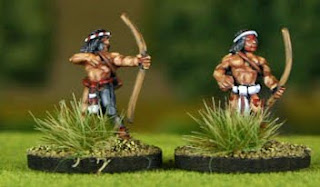
The Chinantecs also used archers, although their role is unclear. They may have formed behind the spear masses to shoot overhead at the enemy, as this is the way they marched to the aid of Cortes during a Conquistador civil war -- intersperced with the spearmen. Or they may simply have marched that way, and formed separately as skirmishers on the flanks or to the front of the spear units.


They also are described as using some slingers, a common troop type throughout ancient Mexico, so we have made some of those as well. They may seem a drab troop type, but the sling was one of the weapons most feared by the Conquistadors.

Next we come to their nobility who, very unusually for Mexico, used the bow, but this was supplemented with the macana, a wooden club/sword edged with obsidian. The macana had a loop for the warrior's wrist. The best interpretation of how they carried it whilst shooting is that they wore it dangling from their wrist as they shot, which to a non-archer like me seems precarious, but I've had archers assure me it would be no problem! You can only see it on one pose here because of the angle, but the nobles all have a macana dangling from their right wrist. They also wear thick fabric armour and helmets which sport fancy feather decorations.


Finally we have a leadership element, a warlord wearing a back standard, and a musician with a conch shell trumpet, common in this part of Mexico.

When the Chinantecs marched to the aid of Cortes, they arrived just too late to fight, and the captured rebels apparently considered this very a good thing! They are quoted as being very impressed with the martial bearing of the warriors. As can be seen from the images, the Chinantecs painted their faces and legs in black and/or red warpaint. They models are depicted in the long breechclout and sandals that were typical of the peoples of the area.

To read more about the Chinantecs, you may wish to consult Ian Heath's wonderful wargamer's guide, ARMIES OF THE AZTEC AND INCA EMPIRES, OTHER NATIVE PEOPLES OF THE AMERICAS, AND THE CONQUISTADORES (Armies of the Sixteenth Century).

This army is a new and fresh element to the DBMM game system, is also provided with a list in Field of Glory, and will also be included in the Field of Glory renaissance list, so it's one of those fortunate forces that sits astride time periods and allows you to use it for several different game systems. Should be released within the week, look for an announcement soon.

Saturday, February 5, 2011

The Control Battalions


After failures using various alien mercenaries to control the rebellious population of Sepulveda 7, and so that the incredibly valuable extraction of Angravium would continue unabated, the overlord of the Jo-eli Freehold, Jellina Jol-i I, decided to genetically craft her own soldiers. For this she used the vast resources of Sepulveda to oppress its own population -- the staggering wealth derived from the planet's huge stores of Angravium financed the scientific and medical research necessary to forge a race of supersoldiers from a witch's brew of human and alien DNA.

Naturally, this was a serious violation of Federal law, and accordingly the work was conducted in complete secrecy in the Black Tower, Jellina's fortress/palace built on an asteroid in the 368 Sumita system. In an effort to conceal the purpose of the research and experiments, each science team's work was very narrowly proscribed, fusing of the research being left to only the most devoted (and thus demented) of her scientists.


But no bottle remains corked forever. One young scientist initially excited about the research he was hired to conduct, David Rimmer, accidentally learned its ultimate goal, to his utter horror. With his own eyes he saw that Jellina was doing the unthinkable -- tapping the DNA of the ghastly creatures of another dimension, her transplanar expeditions finally having found, in the Imperial Maggots of the Maggoton Empire, suitable DNA for melding with that of humanity. What Rimmer spied one day in the top Secret TBA (Transhuman Breeding Area) was almost beyond comprehension -- part human, part maggot, these creatures were homicidal beyond description.

However, Jellina's scientists had found a method to keep them under control, using a chemical cocktail pumped into their lungs in a fine brown mist, constantly administered within the sealed domes of their permanently installed helmets. Sedated in this way, they made the perfect soldiers -- fearless, cunning and obedient.

Rimmer quickly decided on a course of action, sabotaging the TBA and fleeing the Black Tower, wearing as he went one of the special enviro-suits that scientists were provided to protect them from the intensely toxic Maggoton organic material. Rimmer vowed to stop Jellina's plan, and to aid the people of Sepulveda, whom he now realized were not traitorous rebels as Jol-i propaganda asserted, but rather freedom fighters attempting to throw off her oppressive yoke.

This was a setback, but Jellina soon had the TBA restored and thousands of Control troopers were being bred, domesticated, trained and sent off to Sepulveda where they were a rude shock indeed for the Resistance.

Operating in squads of nine, each used a pulse rifle, and the squad also included an SAP (Squad Assault Pulser) and a remote controlled drone which mounted both an HPW (heavy pulse weapon) and a grenade launcher. Operated by a remote pilot, the drone was often in the forefront of battle, its heavy chassis protecting it from small arms fire.

These troopers took the Resistance by storm, pushing them back on all fronts and asserting Jellina's control over the mining of Angravium, not to mention rounding up subjects who were suspected of Resistance ties -- to what fate, it is not known, for once rounded up, they never returned.

As they strode purposefully through the streets of Sepulvedan cities, villages and settlements, these strange masked troopers inspired fear but also intense speculation. Why had no one ever seen them remove their helmets, or eat or drink anything -- ever? Why when they spoke was it in a weird, digitally altered hiss? They became known, with fascination and dread, as the CoBas or, more often, simply the Helmets.

CoBa crews manned (if such a word can be used for transhumans) Jellina's motley collection of vehicles as well. A single company of CoBa infantry could have some of its squads carried in the MDMS Canetoad APC, others in the few remaining Atlas APMs acquired before the Federal trade sanctions, still others in the Hedgehog APC purchased from Nova Respublik, or even in the ramshackle Sod-Kafez 2.51 "Karkwagon" sold throughout the galaxy (usually for a song) by Karkarine military contractors. CoBa urban patrols were often conducted in the Locust Patrol Truck, these sinister black vehicles being widely used to "disappear" Resistance suspects in the middle of the night.

CoBa tankers similarly crewed Jellina's modest tank fleet, again a motley collection of vehicles including a handful of elderly Federal Silers, but mostly Nova Respublik and MDMS vehicles, including the redoubtable Taipan railgun-armed medium tank.

So successful were the oppressive activities of the Control Battalions that the Federation itself chose to intervene in the Sepulvedan Campaign, though at first covertly, sending Federal Marines in Resistance garb to aid the citizens of this war torn planet. For who knew what horror lurked within the bolted-on helmets of these strange troops, Jellina's obediant attack dogs?

We will soon be releasing two packs of Control Battalion infantry -- the rifleman set and the command and weapons set. Look for a release the week of February 7, 2011.